i TO THE MOON AND BACK
For nearly forty years I have split my life between two homes. One home in south-east England the other in eastern France. It has been my habit to drive back and forth between these two homes eight or ten times each year. each trip averaging more than fifteen hundred miles. Fifteen thousand miles a year. Close to six hundred thousand miles in total. The equivalent of driving to the moon and back.
My two homes cost me very little. The English one was cheap because it was listed and in need of work. It was understood that the cost of this work would never be recovered, however much the property market heated-up. And so it has proved.
The French house was a give-away. It was half ruin and the other half was old and cold. The French, I soon found out, do not want to live in such houses.
In England I live in an area of outstanding natural beauty. To the south the land falls abruptly into the sea. This is the Bulwark Shore, the fortified line of the Cinque Ports that stretches from Ramsgate to Hastings. Here for hundreds of years the sand-clogged harbours and stumpy castles and Martello Towers have looked sullenly out across the English Channel to France and equally disdainfully across the Thames Estuary to Essex.
In the 13th Century the burghers of the Cinque Ports were allowed to raise their own taxes and execute their own miscreants. In return they protected the English shore from foreign invaders. This arrangement continued for hundreds of years until England built it’s own navy. By then, of course, it was too late for the people of this coast who harboured an unjustified belief in their own superiority and among whom introspection or self-doubt was and still is as rare as French naval victories.
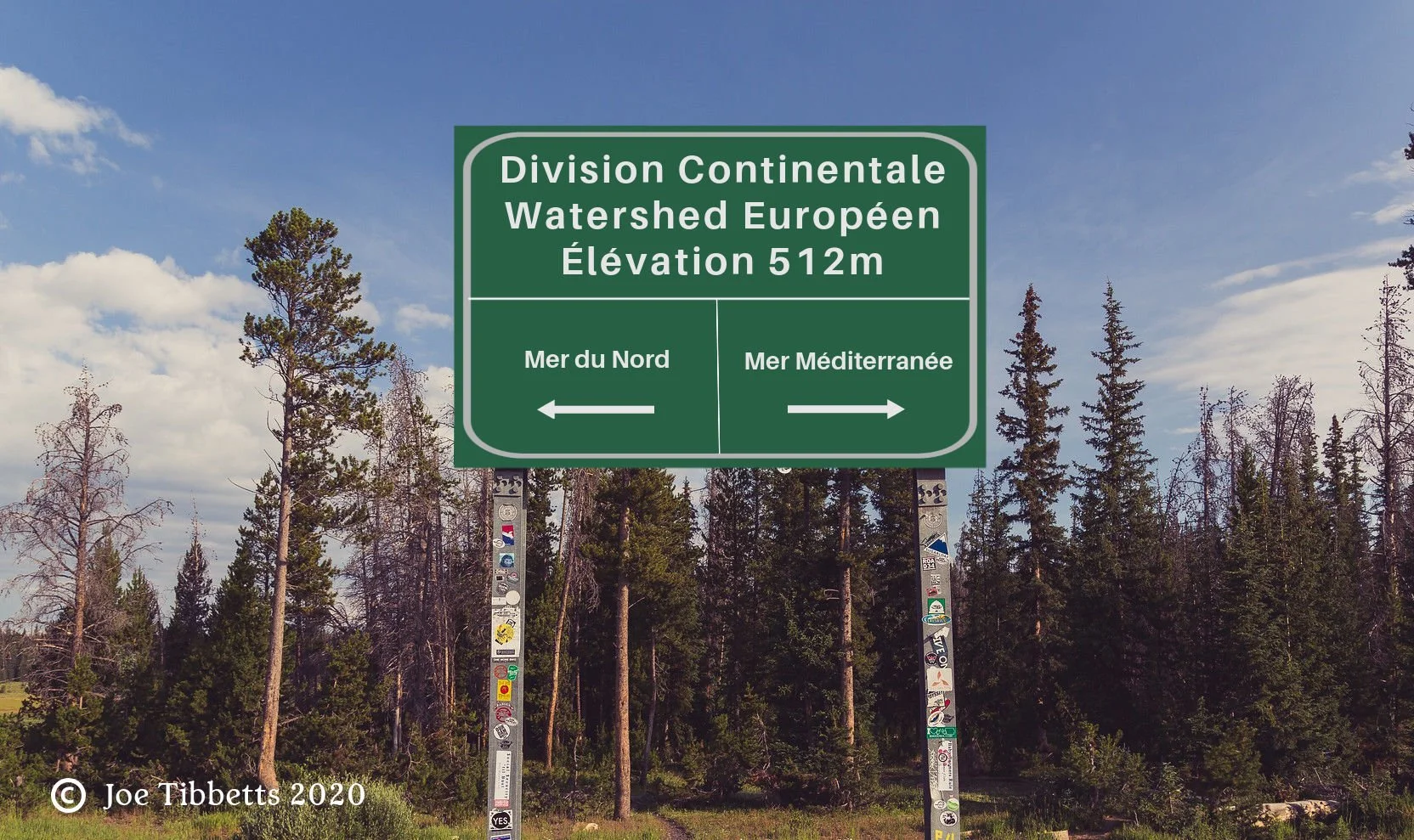
In France I live in another area of outstanding natural beauty, on the edge of a small village, in the middle of a great forest, on the top of a high ridge. This is the European watershed. A mighty ridge that runs from the warm waters of the Mediterranean Sea, close to Gibraltar, to the ice-bound coast of the Russian Arctic. The backbone of Europe.
The water which flows under the bridge in the middle of my village flows north and westwards and ends up in the North Sea. The rain which falls on my friends, who live in a village a couple of miles away, flows south and east and ends up in the Mediterranean Sea.
The forest ~ which the copywriters of the tourism marketing department claim is home to one hundred million trees ~ was already old when the mob stormed the Bastille. When I first got there it was a largely untouched Eden stuffed with wildlife and a spectacular array of plants and wild flowers. In the late 1980s when I arrived very few French people even knew that the old forest existed and I was the only foreigner as far as the eye could see.
ii PAS DE PLAGES, PAS DE PISTES
Shortly after my arrival George, the ancient and crumbling farmer who occupied a few rooms in the ancient and crumbling Chateau in the centre of the village came to introduce himself and check me out. He accepted a glass of my Duty Free whisky and asked me why on earth I had bought the house.
“For holidays” I said. He laughed in open derision.
“Vacances? Mais pas de plages, pas de pistes”.
Thirty-five years later this vast reservoir of rare plants, animals, birds and insects, unspoiled simply because, as George had pointed out, it was totally lacking in beaches and ski-runs, was designated a National Park. The value of my small French investment tripled overnight
The Parc National de Forêts is the largest on the French mainland. It had taken ten yeas of grumpy dissent and angry words to negotiate the inscription as a national park. In the end about a third of the population and the biggest towns and many of the larger villages refused to join. They remain today strung out along the north and eastern border of the Parc, interested but apart, benefiting from but contributing little or nothing to the great de-populated paradise on their doorstep.
Like my neighbours in England, my French neighbours, within and without the park, are fixated on their independence and their long-cherished otherness and, like the burghers and townsfolk of the Cinque Ports, they too don’t do self-doubt. Introspection in the Châtillonnais is as rare as haute cuisine in England .
I have come to love both these places. Most of the people, like people everywhere, are awful and the rest are utterly ghastly. There are, of course, a few exceptions, some live within earshot of the push and pull of waves on gravel along the Bulwark Shore, some live hidden among the streams and trees of the great forest. These two tiny tribes of decent human beings are charming, easy to love, possible to like and vanishingly rare.
While I love the two places I call home, I love the road between them more. When I came to lay out the chapters of this book I found that many of the stories told of road trips. The journey is everywhere and everything. Forty years and well over two million miles in total have taught me that it is better to travel without hope than to arrive. Only lately has it occurred to me that having two homes is the same as having no home at all.
From the start I avoided the national highways and the autoroutes as I drove back and forth. By accident I discovered the appeal of French “D” roads and in particular the deserted, two-lane, back roads of the Cote D’Or, Champagne and the Haute Marne. Like all addicts I was hooked before I knew it.
My original route, which I still follow from time to time, I named after the D2, the road that takes me along the valley of the Marne for fifty-two kilometres between Châlons-en-Champagne and Les Rivières-Henruel. This road passes through a village called Margerie Hancourt. The name seems to me more suited to the heroine of an Agatha Christie murder mystery than a French village built originally as a defensive pinch-point on an arrow-straight Roman road. The road in fact that took the Legions from Rome to the channel ports where, on a clear day, they could see those same cliffs that would become one of the defining landmarks of The Bulwark Shore and where i would have a home two-thousand four-hundred years later.
Thirty years ago, on my way back to England, slowing to negotiate the chicane at the centre of Margerie Hancourt, I noticed five mud-splattered cars parked in front of a roadside farmhouse. It was just before noon. Four men in working clothes were climbing out of one of the cars as I passed. I knew at once where they were going.
I turned my car around and a few minutes later I was standing outside the door of the farmhouse. The door, painted with a pale blue-grey wash, bleached and crazed by sun and wind, was as unremarkable as the building. There was no name, nor any other sign, anywhere on door or building. I went in without knocking and found, as I expected, a rectangular room laid out as a simple restaurant. It was packed with men, mostly farm workers, seated at small tables, waiting for their lunch and steaming slightly as their damp work-clothes began to dry.
iii THE FARMERS WIFE
I hesitated at the door of the dinning room. The farmer’s wife who, I would discover, cooked and served the food, came in from the kitchen at the back and pointed me without a word or a smile to the one remaining empty seat. She knew that I wasn’t French because thirty years ago lunch in France began at noon and only a foreigner would be stupid enough to be late for lunch.
I was served a small gallette of goat’s cheese followed by a côtelette de porc in a thin fragrant gravy with two small potatoes and a single carrot. The vegetables had been simmered in the meat juices. It was a revelation. After that first meal, whenever I drove back to England, I would time my departure so that I arrived at the Margerie Hancourt dining-room at 11.55 on the dot.
There was rarely a seat to spare but somehow they always squeezed me in. The men would shuffle their chairs to make a space, an extra chair would be found, brief greetings would be muttered and the men would resume talking quietly among themselves, leaving me to eat in peace.
On each occasion I spoke a few words in my poor French to the farmer’s wife. She never once, in the four or five years I ate there, offered a single word in return. Nor did she smile. There was, of course, no need. She knew that the food was good. I was English so obviously knew nothing about food and so my words of praise were of little value. There was no choice, no menu to choose from so there was no need to discuss what to order. The single, three course meal was always at a fixed price so there was no need to inquire what my lunch might cost.
Towards the end of my meal the farmer’s wife would pass by my table and after she had gone, a corner of a page torn from a newspaper with the amount-owing written on it in pencil, had appeared as though by magic next to my plate.
I hardly ever heard her speak to any of the other customers. The locals, all men, had no reason to ask or be told what was for lunch or how much it was costing. I never heard any of the men address her by name and so she remained, for me, “the farmer’s wife”. I know farmers, I know them well, many of my relatives were farmers or farm workers in Cumberland and the Lake District. This farmer’s wife, however, was taciturn even by the standards of those who farm sheep on the high fells.
I have been a writer all my adult life. I am, it seems, unable to turn the writing mechanism off. When unable to write, driving alone on a long journey for example, my mind automatically fills the passing hours and miles with fictions, narratives and speculations. I cannot remember, however, speculating on why the farmer’s wife was so withdrawn. Nor can I offer any explanation now.
iv THE HABIT OF A LIFETIME
On one occasion, after maybe twenty visits alone to the Margerie Hancourt dining-room, I took my mother and father with me. They are the two strangers whose story provides the narrative at the heart of this memoir. The Poacher and the Poacher’s wife.
The house I had bought in the Châtillonnais had given us a chance to spend time together. Miraculously, it seemed to me, we had overcome exhaustion and ennui to rebuild the bridges we had burnt decades before. A late-flowering friendship had replaced the anger and hurt of those early years.
My mother and father were both in their late seventies and so our progress from the car to the dining-room was slow. We were three or four minutes late. We paused inside the door. The room was full, every seat was taken. The farmer’s wife glanced at us and without any sign of recognition or greeting, cleared the plates, the cutlery and the newspaper off the table that was her serving-station. One of the men waiting for his lunch stood up without being asked and fetched three chairs from a back room. Neither the man nor the woman spoke or indicated in any way that this was to be our table nevertheless we sat down.
After a moment my mother looked around and said “Do you know? I’m think I’m the only woman here.”
We were served a rough Pâté de Campagne, stinking of pigs liver and garlic, with a single Cornichon and a single lettuce leaf moistened with a vinaigrette. Then a Ragoût de lapin. The stew was made, I am sure, not from the wild rabbits that ran off across the fields as my car rushed by, but from rabbits bred and fattened on the farm.
This stew had been “finished” with mustard and cream and kept ready in the oven so that where the pieces of rabbit rose like islands above the surface of the sauce, a crisp and golden skin of toasted mustard and cream coated the pieces of meat. This masterpiece was served with pommes frites and haricot vert. It was followed by a single, wonderful, aged, goat’s cheese. Something like a Crottin de Chavignol. We had a carafe of very ordinary vin ordinaire. My father and I had a coffee which wasn’t very good either.
I have eaten many wonderful meals in my lifetime. I have travelled the world eating in famous restaurants. I have dined in the homes of the wealthy and, often with a great deal more pleasure, in the homes of the poor and the dispossessed. For a couple of years I had a romance with a famous food writer who fattened me up by testing recipes on me and then told me I was no longer welcome in her bed because I had become too fat. My son, though young, is a chef in a Michelin starred restaurant. I can say, without fear of contradiction, that I know something about food. It is true that I have often had a meal as good as our lunch that day, but I have never had a better one.
We ate in almost total silence. My mother said a few words, asking me questions about the place and so on and then remained silent. As they finished their food my parents, to my astonishment and breaking the habit of a lifetime, mopped up the creamy sauce with a piece of bread. Their childhood lessons in table-manners ~ in my father’s case enforced with blows from a stick ~ had taught them to eat everything you are given but never mop the plate with bread. Too much diligence in cleaning your plate might reveal the poverty you had suffered as a child and, furthermore, make your host feel they had not given you enough to eat.
I asked them what they thought of the food.
“Very nice” my mother said. She paused and then her eyes met mine across her clean and empty plate and she added “Very nice son, thank you for bringing us here.” My father, the Poacher who had eaten more than his share of rabbits and who could have given the farmer’s wife a master-class in enduring silences, rolled his eyes upwards in a pantomime of ecstasy which I am sure he stole from Harpo Marx.
I told my parents how the auberge only served the local workers and only at lunch time. I explained how you could not book but, though it was always full, they always managed to find a seat for me. I told them how much our lunch would cost and my mother exclaimed at how inexpensive it was. I explained how the farmer’s wife kept her costs down by preparing, each day, just enough food for her 25 regular customers plus a serving for her and for her husband.
The farmer, I told them, took his lunch alone in the back kitchen. I described how he occasionally came through - carrying a chair - to sit at one of the tables and talk to his friends and neighbours. I told them how he never sat at my table. My mother looked pained in sympathy. I suggested that he probably spoke no English and that his wife had no doubt told him that my French was incomprehensible.
I explained how I was welcome for the tiny additional income I brought but that I was unimportant and invisible all the same. Then I told them how I liked being invisible and observing while being unobserved, and the conversation turned briefly to my childhood in India.
As we waited for the torn piece of newspaper to miraculously appear on the corner of our table, I watched my mother and father digest both the food and the information I had presented. When young they had both been strikingly good looking. Now they wore the faces that life had brought them. Resting faces, waiting for the next challenge. They had seen it all and done as much. Kind faces, slow to anger, terrible in their wrath. Proud of where they had come from, always moving on.
“But … but what about us?” My mother said, after a few minutes. “Where did she find the food to feed three extra mouths?”
I explained that what we had eaten was, almost certainly, the food intended for the farmer and the farmer’s wife.
When we stood up to go, the farmer’s wife appeared. Normally she was in the back doing things when I was leaving. Now she approached. She faced my mother who placed a hand upon her arm. There was a pause while the farmer’s wife evaluated this uninvited familiarity. Then my mother, who spoke not one word of French, thanked and complimented the farmer’s wife in English. In return, the farmer’s wife smiled a small but wonderful smile. Sunrise on a spring day after a bitter winter. A winter in which a long and grievous war has been fought and won, but at a terrible cost. Then the farmer’s wife leaned in and kissed my mother on both cheeks and we went outside and, without speaking, got into the car and resumed our journey.
For twenty years I tried to recreate that dish of rabbit, cream and mustard. I got close but there was always something missing. I tried adjusting the quantities of the different ingredients. I tried different ingredients, different combinations of herbs, unpasteurised cream, mustard brought from Dijon, hare instead of rabbit.
It took years for me to work out the two essential ingredients that were missing. They are both long gone now, unaccountably breaking the habit of a lifetime which was to be quietly alive and always there when needed.
The Landscape of Denial
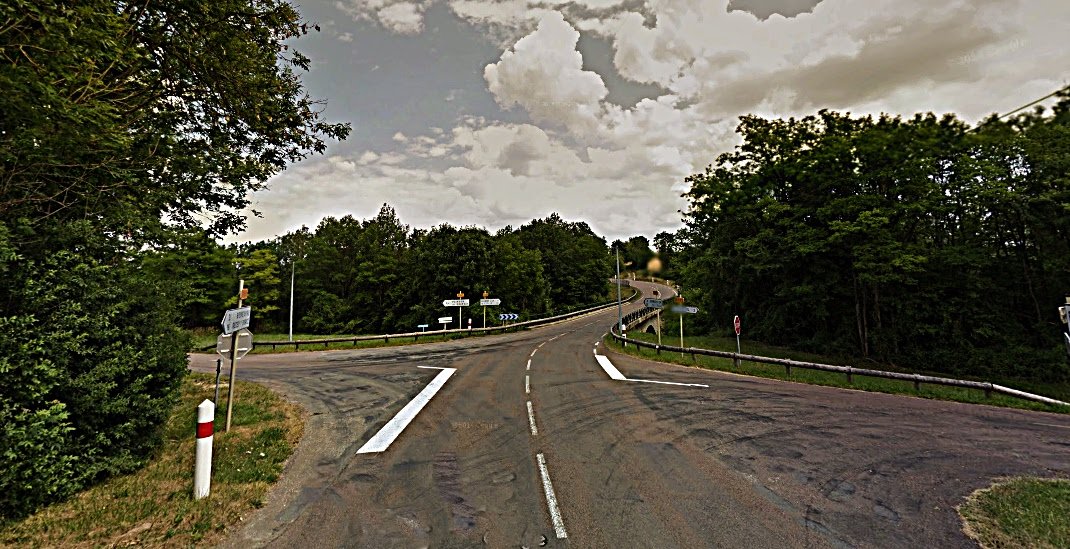
If you drive from Recey sur Ource to Dijon on the D959, after 16km, before you get to Grancey le Chateau, you come to the crossroads shown above. Stop and get out of the car and look in the direction of Dijon straight ahead!
If it is raining while you are there the rain that falls behind you flows eventually into the North Sea or the Atlantic Ocean and the rain that falls in front of you goes into the Mediterranean sea. Stand at the crossroads and you are standing on "the roof of Europe" for this is the Continental Divide. Our own little bit of the European Watershed with it’s southern end near Gibraltar and it’s northern end in the Russian Arctic.
Interestingly, the historic man-made border between the Cote d"Or and the Haute Marne which is also the border between Grande Est and Bourgogne Franche-Comte at this point follows the Continental Divide. And the Continental Divide defines one edge of the Parc national de forêts
The administrators of the Parc national de forêts, are not best pleased with me. My first mistake was to mention the European Watershed. The did not know about the Continental Divide and they were not aware that it ran through the Parc. It’s not surprising they didn’t know as they were all experts in trees and other sylvan flora and fauna, Not a geologist or geomorphologist, or a social scientist or cultural historian among them. Whereas I could lay claim, in some small way, to being all four.
Furthermore they had chosen Arc en Barrois for their headquarters in the north-east corner of the Park a long drive through a thick forest to the south east border of the park where the great ridge lies. I had the impression that non of them had actually been to the part of the park I was talking about.
They should not, of course, be blamed for choosing Arc en Barrois for their HQ even though there were other, perhaps more fitting villages, more centrally placed in the Parc national de forêts that they might have chosen. Most of the people working for the park were young and liked Arc en Barrois because it was close to the autoroute and consequently when they left the office it was quick to exit the Parc national de forêts and find culture and nightlife or just go to visit a close friend or go home for, at that time, none of them actually lived in the park.
They were resistant when I suggested that the Continental Divide should be acknowledged and incorporated into the “story of the park”. They were “the rightful owners” and I was just a visitor and a foreigner. My offer to help them, in any way I could, without payment was rebuffed. Which was perhaps surprising since I had served on the steering group of ICOMOS the International Council on Monuments and Sites (HQ in Paris) and as an advisor to the steering group that succeeded in having the Lake District National Park in England accepted as a UNESCO World Heritage Site.
Things went from bad to worse when engaged in a discussion in the bar in Recey sur Ource with a young Frenchman who unbeknown to me worked for the Park administration. If I had known who he worked for I almost certainly would not have advanced my ideas on what the Parc national de forêts was all about.
My argument was, and still is, that the trees are an irrelevance. I suggested that the name of the park should be changed to reflect the reality that it was the water and the drainage patterns and the water management infrastructure and the watershed and the deeply incised and tilted Plateau de Langres that defined everything that was special about the park.
The trees themselves which are, of course beautiful and numerous are neither rare nor threatened. They certainly attract visitors who like the idea of walking or riding beneath trees. But in the past they hampered movement, harboured bandits and were only useful for firewood and building. And they themselves, of course, would not be there but for the supply of water. The historic paths which carried pilgrims from Canterbury to Rome and on to the Holy Land passed ~ still pass ~ through the park by way of river valleys. The roads to the Crusades skirted the park in river valleys. A staggering collection of mighty rivers including the Aube, the Marne, and the Seine and the river system that starts as the Tille and becomes the Saone and then the Rhone and so into the Mediterranean Sea and other rivers that flow east into the basins of eastern Europe and central Asia and north to the arctic wastes all rise in or close to the Parc national de forêts.
The social history and modern social fabric of the area depends on water. The pattern of settlements followed the water in the valleys, valleys formed by water. The people who lived in these settlements spent their lives managing water, water for farming, water for animals. water to drive machinery to do everything from making bread to making iron. Each village has at its centre a wash-house where people and products were washed and round which the social life of the village revolved. These washouses are still there for the most part lovingly preserved. The rare birds, the flora and fauna that congregate in the tuffa swamps, of which the park administration are rightfully proud, care little about the trees but rely on water for their very life.
In the last decade there has been a seven year drought in the Parc national de forêts. During the drought many of the mill races and the sluice gates and ponds that are found in the centre of so many of the villages became clogged with silt and dead vegetation, the sluice gates rusted shut. Then in 2024 there was a great flood. In the valley of the upper Aube, a couple of miles as the Buzzards fly from my home, roads were swept away, buildings were destroyed, and parts of the forest were closed while the roads and ditches, the embankments and watercourses were cleaned out and repaired.
The trees were not as far as I could tell affected by the drought or the flood. The damage to the buildings and the costs to the villagers however were huge and multiplied many times over because when the waters came the valleys were blocked and the sluice gates could not be opened. At each village the floodwaters overspilled the broken banks of the ponds and the man made watercourses and filled the basements and the lower floors of the houses. There are, it seems, no qualified people in the park or anywhere in the Chatillonaise employed to manage the water and the water courses and the water related infrastructure.
The administration of the Parc national de forêts, however, has been busy signposting woodland walks and identifying tree types.